
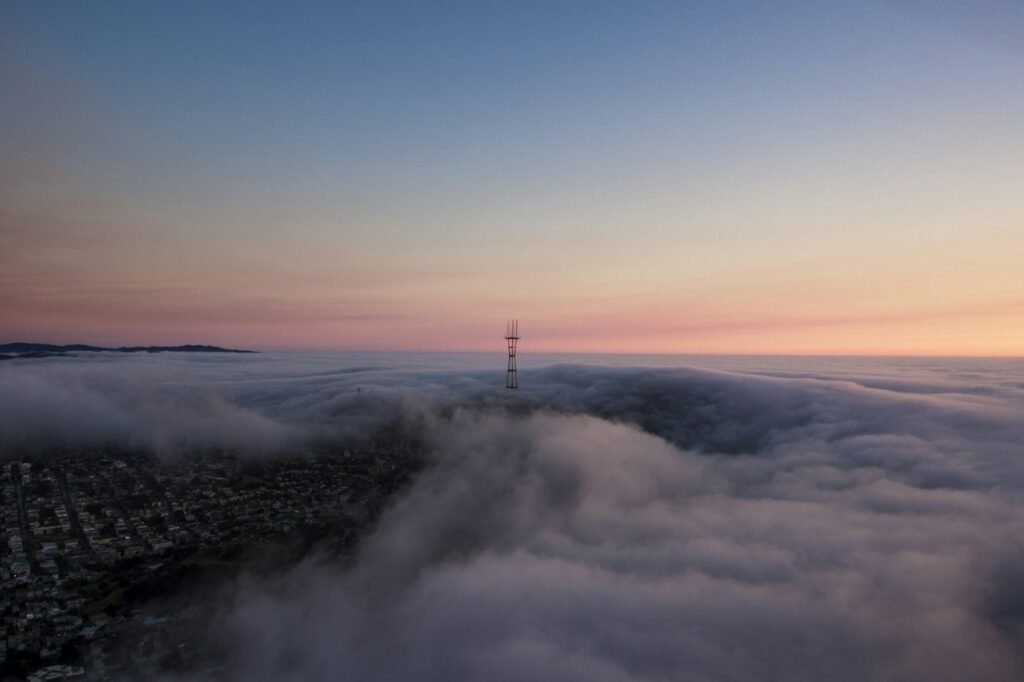
The most useful thing anyone can tell you about San Francisco weather is that the seasons are shifted. Summer is the cold, gray season. Fall is the warm one. Everything else follows from that.
The Real Seasons
Summer, June to August, is fog season. Hot air in the Central Valley pulls cool ocean air in through the Golden Gate, and the fog sits over the western half of the city for days at a time. Mornings and evenings are in the fifties. Locals call it Fogust and complain about it every year.
September and October are the warm, clear months and the best time to visit or to plan a beach day. September is the single warmest month of the year here, with average highs around seventy.
November through March is the rainy season, with December, January and February the wettest months. Highs stay in the upper fifties, so it is mild rather than cold, but it is genuinely wet: downtown averages about 23 inches of rain a year, and roughly 84 percent of it falls in these five months.
April and May are the transition, often lovely, with the fog building by late May.
When Is the Rainy Season in San Francisco?
San Francisco’s rainy season runs from November through March. Those five months bring about 19.3 of downtown’s 22.9 inches of yearly rain, roughly 84 percent, in NOAA’s 1991-2020 climate normals. December is the wettest month (4.76 inches), with January and February close behind. June through September is nearly dry. (As of October 2026.)
In the wettest months, expect measurable rain on about eight days a month, usually in storms that pass through in a day or two rather than all-day drizzle. For a wet day with kids, see our rainy-day things to do and the rainy weekend plan.
Average Temperatures by Month
These are NOAA’s 1991-2020 climate normals for the downtown San Francisco station (the normals the National Weather Service uses), in Fahrenheit, high and low:
January 58/47 · February 60/48 · March 62/49 · April 63/50 · May 64/51 · June 67/53 · July 66/54 · August 68/56 · September 70/56 · October 70/54 · November 64/51 · December 58/47
Notice the range. There are only about twelve degrees between the coldest month and the warmest. San Francisco does not really have a summer or a winter; it has a gray season and a clear one.
Winter evenings are short, too: the sun sets as early as 4:51pm in early December, and it is dark by about 5:20pm. Our answer to when it gets dark in San Francisco in winter has sunrise, sunset and dark times from October to March.
Microclimates Are Not a Myth
On the same July afternoon, the Mission, Noe Valley, Potrero Hill and Bayview can be sunny and in the seventies while the Outer Sunset and Outer Richmond sit under fog in the upper fifties. Twin Peaks acts as a wall. Downtown and the waterfront fall in between and can flip in an hour.
The practical version: if your day is fogged out on the west side, drive east. If you want fog, drive west. Both take twenty minutes.
Wind
Afternoon wind is the other thing visitors underestimate. Ocean air accelerates through the Golden Gate as the inland valleys heat up, so wind is strongest in the mid-to-late afternoon and strongest overall from May through August. Crissy Field, Ocean Beach and every hilltop are noticeably colder than the forecast suggests. Mornings are calmer, which is why we put beach and bike plans early in the day.
What to Pack for Kids
Summer: long sleeves, a fleece and a windbreaker, even in July, plus long pants for the coast and closed-toe shoes. A sun hat for the east side and a beanie for the west side is not a joke.
September and October: t-shirts by day, one warm layer for the evening. This is the stretch when the beach actually works.
Winter: a rain jacket with a hood, waterproof shoes and warm layers. Umbrellas fail in the wind; hoods do not.
Spring: layers again, with sunscreen. Fog does not stop sunburn.
What Should You Wear in San Francisco in November?
Pack for cool and damp. November averages a high of 64°F and a low of 51°F downtown, with 2.6 inches of rain falling on about eight days, as the rainy season starts (NOAA 1991-2020 normals, as of October 2026). Bring a hooded rain jacket, a fleece or sweater for evenings, long pants and shoes that can get wet.
Temperature and rainfall normals: NOAA NCEI U.S. Climate Normals, 1991-2020, San Francisco Downtown station (checked October 2026).
What Is the Weather Like Month by Month?
NOAA 1991-2020 normals for downtown San Francisco, with average rain in inches. Note how little the year moves: about twelve degrees between the coldest month and the warmest.
| Month | Average high | Average low | Average rain | What it feels like |
|---|---|---|---|---|
| January | 58°F | 47°F | 4.40 in | Wet, mild, quiet |
| February | 60°F | 48°F | 4.37 in | Still wet |
| March | 62°F | 49°F | 3.15 in | Drying out |
| April | 63°F | 50°F | 1.60 in | Clear spells, breezy |
| May | 64°F | 51°F | 0.70 in | Lovely, fog building late |
| June | 67°F | 53°F | 0.20 in | Fog season starts |
| July | 66°F | 54°F | 0.01 in | Cold and grey on the coast |
| August | 68°F | 56°F | 0.06 in | Peak Fogust |
| September | 70°F | 56°F | 0.10 in | The warmest, clearest month |
| October | 70°F | 54°F | 0.94 in | The second-best month |
| November | 64°F | 51°F | 2.60 in | Rain returns |
| December | 58°F | 47°F | 4.76 in | Wettest month, lights everywhere |
Local Legend: “The Coldest Winter I Ever Spent Was a Summer in San Francisco”
What is actually true: Twain never said it. Quote Investigator traced the joke back to the 1700s, when it was told about the actor James Quin, and found it attached to other chilly places, Duluth among them, before it ever landed on San Francisco. It calls the line “the coolest thing Mark Twain never said.” The joke does get the weather right: summer fog keeps much of the city cool, as our what to wear guide explains.
Prices and hours were checked in September 2026 and can change, so confirm before you go.
More Guides
Presidio Ghosts and the Pet Cemetery: Legends and Facts
The Presidio’s ghost stories and the Pet Cemetery legends, told as stories and then checked against the Presidio Trust and National Park…
Read the guide →Chinatown Tunnels Myth: What Is Under Grant Avenue
The claim that a maze of tunnels runs under San Francisco Chinatown, traced to 1800s tour guides, and what SFGATE and KALW…
Read the guide →Is Coit Tower a Fire Hose Nozzle? The Legend and the Facts
The story that Coit Tower was shaped like a fire hose nozzle to honour firefighters, and what San Francisco Recreation and Parks…
Read the guide →Questions People Ask About San Francisco Weather: Fog, Microclimates and What to Wear
Why is San Francisco so cold in summer?
Because hot air in the Central Valley pulls cool ocean air in through the Golden Gate, which drags fog over the western half of the city for days at a time. July mornings and evenings sit in the fifties. Locals call it Fogust.
What is the best month to visit San Francisco?
September, then October. September is the warmest month of the year here, with average highs around seventy and far less fog than summer. It is also when the big free festivals happen.
What should you wear in San Francisco?
Three layers you can strip off and stuff in a bag: a t-shirt, a long sleeve or fleece, and a windproof jacket. Add long trousers for the coast and closed shoes for hills. In winter, swap the jacket for a hooded rain shell, because umbrellas lose to the wind.
Is it really 20 degrees warmer in the Mission than at Ocean Beach?
On a summer afternoon, often yes. Twin Peaks blocks the fog, so the Mission, Noe Valley, Potrero Hill and Bayview can be ten to twenty degrees warmer than the Outer Sunset or the Outer Richmond at the same hour. If your day is fogged out, drive east.
When does it rain in San Francisco?
Mostly from November through March, which brings about 84 percent of downtown's roughly 23 inches of yearly rain (NOAA 1991-2020 normals). December is the wettest month, with January and February close behind, and June through September is nearly dry.
What should you wear in San Francisco in November?
Layers and a hooded rain jacket. November averages 64°F by day and 51°F at night downtown, with about 2.6 inches of rain on roughly eight days (NOAA 1991-2020 normals). Add a fleece for evenings, long pants and shoes that can get wet.
More to Explore
Happening Soon
- Treasures of the Pharaohs Sat, Aug 1, 2026 – Jan 31, 2027 · de Young Museum
- Ferry Plaza Farmers Market Sat, Sep 12 – Dec 31 · Ferry Building Plaza
- Heart of the City Farmers Market Sun, Sep 13 – Dec 31 · Fulton Plaza, Civic Center
- SF State Observatory Public Nights (Wed–Fri, through Dec 4) Thu, Oct 1 – Dec 4 · SF State Observatory, Thornton Hall
Places to Check Out
- Alta Plaza Park Parks & Playgrounds
- Angelo J. Rossi Playground Parks & Playgrounds
- Asian Art Museum Museums
- Bi-Rite Creamery Ice Cream & Treats
Cite this page: Project SF, “San Francisco Weather: Fog, Microclimates and What to Wear”, projectsf.com/guides/san-francisco-weather-what-to-wear/ (updated ).