
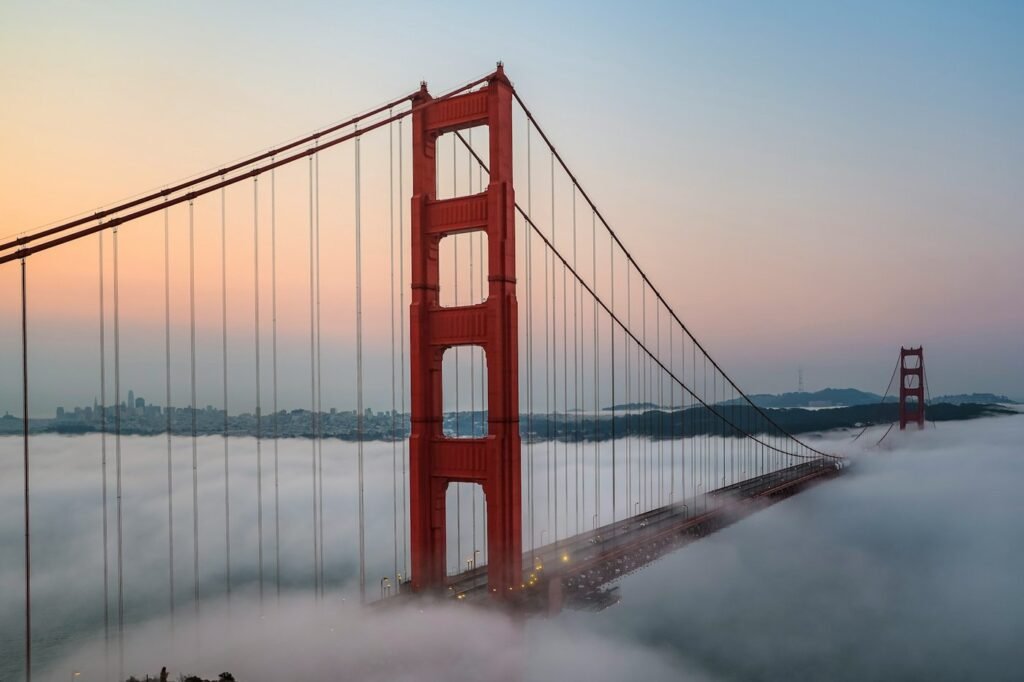
Welcome to San Francisco! The city is small (about 49 square miles), but it takes a while to learn how it works: which Muni card to tap, why your car needs its wheels turned, and why July calls for a jacket. This guide covers the practical stuff for your first few months, with current 2026 prices and rules and links to the official sources.
Get to Know the Neighborhoods
San Francisco is a city of distinct neighborhoods, each with its own weather, food and personality. Here’s a quick cheat sheet:
- Mission District: warm, sunny and lively, with taquerias, mural-lined alleys and Dolores Park, the city’s weekend living room.
- SoMa: former warehouses turned tech offices and lofts, home to SFMOMA, Yerba Buena Gardens and Oracle Park.
- Marina: flat, bright and active, with joggers on Marina Green, brunch on Chestnut Street and the Palace of Fine Arts.
- Pacific Heights: grand Victorian and Edwardian homes, bay views from hilltop parks and upscale shopping on Fillmore Street.
- Nob Hill: grand hotels, Grace Cathedral and cable cars at the top of a very steep climb, right next to downtown.
- Russian Hill: leafy stairways, hidden lanes and the crooked block of Lombard Street, with Polk Street’s cafes below.
- North Beach: the historic Italian quarter: espresso bars, focaccia, Washington Square and City Lights Bookstore.
- Hayes Valley: boutiques, wine bars and Patricia’s Green, a short walk from the Symphony, Opera and City Hall.
- Noe Valley: a sunny, village-like neighborhood centered on 24th Street’s cafes and weekend farmers market.
- Sunset (Inner & Outer): pastel houses running down to Ocean Beach; the Inner Sunset is lively, the Outer foggier and surfier.
- Richmond (Inner & Outer): between Golden Gate Park and the Presidio, with some of the city’s best dim sum along Clement and Geary.
- Potrero Hill & Dogpatch: a sunny hilltop with skyline views above a former industrial waterfront full of makers and galleries.
- Bernal Heights: a close-knit, dog-loving hillside with 360-degree views from Bernal Heights Park and a small-town main street on Cortland.

Getting Around
Muni (Buses, Trains & Cable Cars)
- Single ride: $2.85 with Clipper or tap-to-pay, $3.00 cash, including a two-hour transfer window.
- Monthly pass: the adult “M” pass (Muni only, including cable cars) is $86. The “A” pass adds BART rides within SF for $104.
- Cable cars: $9 one way (rising to $12 on January 4, 2027). Buy ahead to board at the turnarounds from 8am–8pm.
- Coming changes: MuniMobile stopped selling single rides on September 1, 2026. The 15¢ Clipper discount ends in January 2027, and daily fare capping is planned for summer 2027.
Clipper and Tap-to-Pay
Since December 2025 you can tap a contactless Visa, Mastercard, Amex or Discover card (or your phone wallet) on Muni, BART and the ferries. You’re charged the adult Clipper fare, and transfer discounts still apply. Tap-to-pay doesn’t work on cable cars, and seniors, youth and Clipper START riders need a physical Clipper card ($3 at BART machines) to get discounted fares. Clipper info
BART, Bikes, Ferries and Robotaxis
- BART: fares are based on distance, so tap in and out with the same card or phone. You need at least $2.55 on an adult card to enter. bart.gov
- Bay Wheels bike share: $1 to unlock plus $0.19/min on classic bikes or $0.49/min on e-bikes. A day pass is $15, a monthly membership $29 and an annual one $165. Income-qualified residents pay $5. Pricing
- Ferries: leave from the Ferry Building. SF Bay Ferry to Oakland/Alameda is $5.10, Golden Gate Ferry to Sausalito $8.50 with Clipper.
- Waymo: driverless rides operate 24/7 across San Francisco and a wide Bay Area service area through the Waymo app. At SFO, pickups are at the Rental Car Center (take AirTrain), not the terminals.

Driving & Parking (Read This Before You Get a Ticket)
- Curb colors: red means no stopping; white is 5-minute passenger loading; green is short-term parking; yellow is commercial loading; blue requires a disabled placard. SFMTA guide
- Street sweeping: parking during posted cleaning hours costs $105. Once the sweeper has passed, you can legally park again.
- Curb your wheels: on any grade of 3% or more it’s the law: wheels away from the curb facing uphill, toward the curb facing downhill, parking brake set. The fine is $48.
- Other rules: no parking in one spot for more than 72 hours, none within 20 feet of a crosswalk, and never block any part of a driveway.
- Residential Parking Permit: $224 a year (or $112 with under six months left). You need California registration and insurance at your SF address. Apply
- DMV deadlines: California requires new residents to get a CA driver’s license within 10 days and register an out-of-state car within 20 days. Get the REAL ID version if you’ll fly with it. DMV: new to California
Weather: Pack Layers, Always
San Francisco’s warmest months are usually September and October, with average highs around 70°F. Summer is often foggy and cool, with July highs around 67°F. Winter is mild (January highs about 57°F). The city also has microclimates: the ocean-side Sunset and Richmond can be cold and gray while the Mission and Potrero Hill are sunny on the same afternoon. Locals affectionately call the summer fog “Karl.” A light jacket you can take off is the year-round uniform.

City Services to Set Up
- SF311: call 3-1-1 (or 415-701-2311), use the app or go online 24/7 for potholes, graffiti, illegal dumping and other non-emergency issues. sf311.org
- Library card: free for all California residents. Apply online, then show photo ID at any branch. It includes e-books, streaming and free museum passes. sfpl.org
- Three bins: sorting is mandatory: blue for recycling, green for compost (food scraps and food-soiled paper), black for landfill.
- Bulky-item pickup: Recology collects furniture and mattresses from the curb for free (twice a year for residential accounts). Book two weeks ahead. Recology
- SF City ID: a free city ID card for residents of any age, valid for two years. Book through 311. sf.gov
- Register to vote: at registertovote.ca.gov. The deadline for the November 3, 2026 election is October 19; same-day registration is available after that.
- Courts & picnic areas: tennis and pickleball courts are booked online through SF Rec & Park, usually opening seven days ahead at 8am.
Be Ready for Earthquakes
Every San Franciscan should be able to manage on their own for at least 72 hours. SF72 recommends storing a gallon of water per person per day, three days of shelf-stable food, a household plan, and getting to know your neighbors. Sign up for AlertSF (text your ZIP to 888-777) for official emergency alerts. And if you’ve heard about a Tuesday-noon siren test: the city’s outdoor sirens have been silent since 2019, so rely on phone alerts instead.
Local Tips & Etiquette
- Say “SF” or “the City”: most locals wince at “Frisco” and “San Fran.”
- Tap and go: have your Clipper card or phone ready before you board Muni.
- Escalators: stand on the right and walk on the left.
- Compost is normal: when in doubt, food-soiled paper goes in the green bin.
Your First-Week Checklist
- Set up Clipper on your phone, or tap a contactless card.
- Download SF311 and text your ZIP to 888-777 for AlertSF.
- Start a 72-hour earthquake kit.
- Book the DMV: license within 10 days, car registration within 20.
- Apply for a Residential Parking Permit if you’ll park on the street.
- Read the street-sweeping sign on your block.
- Set up blue, green and black bins in your kitchen.
- Get a free library card.
- Register to vote at your new address.
- Explore your neighborhood’s family favorites and this weekend’s events.
Explore for Free (or Close to It)
- Museums: the de Young and Legion of Honor are free for Bay Area residents every Saturday and for everyone on the first Tuesday. The Asian Art Museum is free on the first Sunday. See our free museum days guide.
- Golden Gate Park gardens: SF residents with proof of address get free entry to the Japanese Tea Garden, Conservatory of Flowers and SF Botanical Garden. Details
- Lands End & the Presidio: cliffside trails, the Sutro Baths ruins, Presidio Tunnel Tops and the free Presidio GO shuttle.
- Library museum passes: reserve free passes to more than a dozen museums with Discover & Go. sfpl.org

The History
Earthquakes here are real and the “earthquake weather” myth is not; the facts and the myth are in our history of the 1906 earthquake and fire.
Fares, fines and rules were checked against official sources in September 2026. Several Muni changes take effect in 2027, and we’ll update this guide as they happen.
Correction, 15 October 2026: this guide said you must buy cable car fares in advance to board at the turnarounds from 8am to 5pm. SFMTA’s cable car page says the pre-purchase rule applies 8 a.m. to 8 p.m. daily (sfmta.com/getting-around/muni/cable-cars).
More Guides
History Events in San Francisco: Parades, Commemorations and Tours
History events in San Francisco from November 2026 to mid-2027: parades, commemorations, tours and talks, with the organizers' own dates.
Read the guide →Historic Tours in San Francisco: Walking Tours, Trails and Ranger Programs
46 historic tours in San Francisco: free SF City Guides walks, Alcatraz and Fort Point, cable cars and trails, with prices and…
Read the guide →San Francisco National Historic Landmarks: 15 Confirmed, by Neighborhood
15 National Historic Landmarks in San Francisco confirmed on National Park Service pages, by neighborhood, with dates and visiting status.
Read the guide →Questions People Ask About New to San Francisco? The Complete Guide to Settling In
What surprises people most when they move to San Francisco?
The weather. Summer is the cold season, September is the warm one, and two neighborhoods three miles apart can differ by twenty degrees on the same afternoon. After that, it is the parking rules: street cleaning tickets are about $105 and the signs are on the block you just parked on.
Do you need a car in San Francisco?
Not to live here, and many households do without. Muni plus BART covers most daily trips, kids ride Muni free, and Bay Wheels bikeshare fills the gaps. A car mainly buys you weekend trips out of the city, at the cost of parking permits, tickets and break-ins.
How worried should you be about earthquakes?
Prepared rather than worried. The city’s own advice is a stay box with about a week of water and supplies, a go bag per person, and securing tall furniture. Install the free MyShake app for early warning and sign up for AlertSF text alerts.
What is 311 in San Francisco?
The city’s non-emergency line, by phone or app, for street cleaning, abandoned vehicles, graffiti, potholes and illegal dumping. It works, and it is the fastest way to get something fixed on your block.
More to Explore
Happening Soon
- Ferry Plaza Farmers Market Sat, Sep 12 – Dec 31 · Ferry Building Plaza
- Heart of the City Farmers Market Sun, Sep 13 – Dec 31 · Fulton Plaza, Civic Center
- Clancy’s Pumpkin Patch Fri, Oct 2–31 · Clancy's Pumpkins & Christmas Trees
- Día de los Muertos & Halloween at Mission Community Market Thu, Oct 29 · Mission Community Market
Places to Check Out
- Alta Plaza Park Parks & Playgrounds
- Angelo J. Rossi Playground Parks & Playgrounds
- Bird & Beckett Books & Records Shops
- Chinatown/Him Mark Lai Branch Library Libraries
Cite this page: Project SF, “New to San Francisco? The Complete Guide to Settling In”, projectsf.com/guides/new-to-san-francisco-guide/ (updated ).