
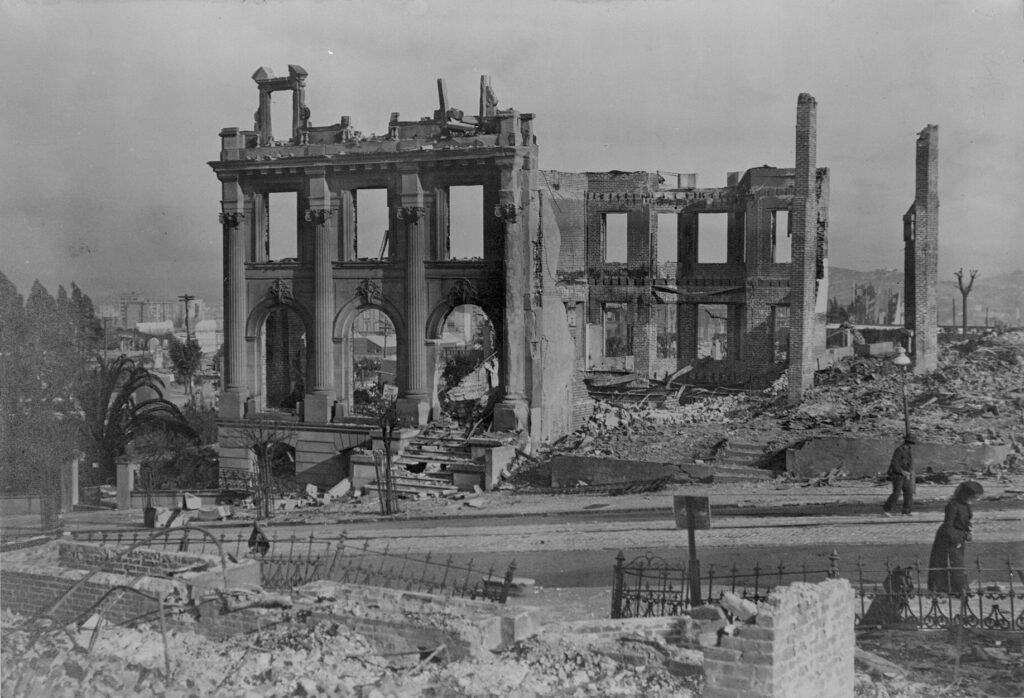
At 5:12 a.m. on 18 April 1906 the San Andreas Fault ruptured along nearly 300 miles, and the fires that followed burned San Francisco for three days. Half of the city’s roughly 400,000 people lost their homes. This page sets out what the government sources say, and where they disagree.
The 1906 Earthquake and Fire at a Glance
| Measure | What happened | Source |
|---|---|---|
| 5:12 a.m., 18 April 1906 | The earthquake strikes; USGS puts it at magnitude 7.8 and says the ground shook violently for more than 40 seconds | USGS |
| 18–21 April | Fires started by broken gas mains rage out of control for three days | USGS |
| Burned area | 4.7 square miles, nearly 500 city blocks | NOAA via USGS; NARA |
| Buildings | 28,188 destroyed: 24,671 wood and 3,168 brick | USGS |
| People | About 400,000 lived in the city; 225,000 were left homeless | USGS |
| Deaths | At least 3,000 by the USGS count; earlier counts were far lower (see below) | USGS |
| Cost | $400 million in 1906 dollars for earthquake and fire together; $80 million from the earthquake alone | NOAA via USGS |
The Earthquake
The USGS says the earthquake struck at 5:12 a.m. and ruptured nearly 300 miles of the San Andreas Fault. Its Facing the Great Disaster report gives the magnitude as 7.8; the USGS’s own event page for the quake is titled magnitude 7.9, so the number depends on which USGS publication you read. The National Archives says the shaking lasted under a minute; the USGS says more than 40 seconds.
The Fire
The earthquake broke gas mains, and the USGS says the fires they started raged out of control for three days. The National Archives puts the loss at nearly 500 city blocks; NOAA’s figure, quoted by the USGS, is a burned district of 4.7 square miles. Officials destroyed about $30,000 worth of liquor from saloons and liquor stores to limit the spread of fire and the threat of mob violence, according to the National Archives.
How Many People Died
This is the question the sources answer differently. The Army’s 1906 relief report, by Greely, counted 498 dead in San Francisco, 64 in Santa Rosa and 102 in and near San Jose. A 1972 NOAA report called 700 to 800 a reasonable figure. The researchers Gladys Hansen and Emmet Condon found over 3,000 deaths directly or indirectly, and the USGS’s headline figure is “more than 3,000”. We give the range rather than choose one.
The Aftermath
The USGS counts 225,000 people homeless. The National Archives says survivors slept in tents in city parks and the Presidio, queued for food and cooked in the street to reduce the risk of more fires. The Chinese community was treated differently: the NPS says Chinatown’s roughly 15,000 residents lost nearly everything, most left for Oakland, only about 400 stayed in San Francisco, and the Army moved those who remained into segregated camps, the last near Fort Point in the Presidio. Read the rest in our Chinatown history.
The cable cars were hit too: the Cable Car Museum says electric streetcars became the preferred transit after 1906, though some cable lines were rebuilt. See the cable car history.
Local Legend: The Sourdough Starter That Survived 1906, Fisherman’s Wharf
What is actually true: The rescue is company and family lore, told by Boudin’s museum and by SF Travel; we found no independent record of it. Boudin’s own history says the bakery dates to 1849, that it is “believed” Isidore Boudin got his starter from a Gold Rush miner, and that Louise ran the bakery after his death in 1887. Boudin says it still adds a portion of the original mother dough to every batch. One myth KQED does knock down: the famous sourdough bacteria was first identified here but is not unique to San Francisco.
Local Legend: “Earthquake Weather”
What is actually true: There is no such thing. Asked by KTVU whether earthquake weather exists, USGS research geophysicist Annemarie Baltay answered: “Absolutely not.” Earthquakes happen somewhere in the world every day, she pointed out, in hot places and very cold ones alike.
Still Unconfirmed
- The magnitude. USGS publications give 7.8 and 7.9. We have not found a single agreed figure on the pages we read.
- The death toll. The sources range from 498 in San Francisco to more than 3,000 overall, depending on who counted and what counts.
- Chinatown’s own toll. The USGS casualties page we read does not break out deaths in Chinatown.
Sources
- U.S. Geological Survey, Facing the Great Disaster, read 20 October 2026.
- U.S. Geological Survey, Casualties and damage after the 1906 earthquake, read 20 October 2026.
- National Archives, San Francisco Earthquake, 1906, read 20 October 2026.
- National Park Service, Presidio, 1906 Earthquake: Chinese Displacement, read 20 October 2026.
Figures are as the sources state them, read on 20 October 2026. Where sources differ, we say so above.
More Guides
San Francisco Cable Car History: 1873 to Today
San Francisco cable car history with dates and sources: Hallidie's first run in 1873, the 1947 vote that saved them, the 1964…
Read the guide →San Francisco Chinatown History: From the Gold Rush to 1906 and After
San Francisco Chinatown history with dates and sources: the Gold Rush, the 1882 Exclusion Act, the 1906 fire and the failed plan…
Read the guide →Alcatraz History: Lighthouse, Fort, Prison and the 1969 Occupation
Alcatraz history in order, from the 1854 lighthouse to the 1934-1963 federal penitentiary and the 1969-1971 Native American occupation, with the source…
Read the guide →Questions People Ask About 1906 San Francisco Earthquake and Fire: What Happened
What time did the 1906 San Francisco earthquake hit?
At 5:12 a.m. on 18 April 1906, according to the USGS. The ground shook for more than 40 seconds and the fault ruptured along nearly 300 miles.
What was the magnitude of the 1906 earthquake?
The USGS’s Facing the Great Disaster report says 7.8; the agency’s event page for the earthquake is titled magnitude 7.9. The figure differs by publication.
How many people died in the 1906 San Francisco earthquake?
Estimates range widely. The Army counted 498 in San Francisco in 1906, NOAA later said 700 to 800 was reasonable, and researchers Gladys Hansen and Emmet Condon found over 3,000. The USGS gives more than 3,000.
How long did the 1906 fire last?
Three days. The USGS says fires from broken gas mains raged out of control for three days, destroying about 4.7 square miles, nearly 500 city blocks.
How many people were homeless after 1906?
The USGS counts 225,000 of the city’s roughly 400,000 people. The National Archives says about half the city lost their homes.
More to Explore
Happening Soon
- Treasures of the Pharaohs Sat, Aug 1, 2026 – Jan 31, 2027 · de Young Museum
- Ferry Plaza Farmers Market Sat, Sep 12 – Dec 31 · Ferry Building Plaza
- Heart of the City Farmers Market Sun, Sep 13 – Dec 31 · Fulton Plaza, Civic Center
- SF State Observatory Public Nights (Wed–Fri, through Dec 4) Thu, Oct 1 – Dec 4 · SF State Observatory, Thornton Hall
Places to Check Out
- Aquarium of the Bay Attractions
- Asian Art Museum Museums
- Balmy Alley Murals Attractions
- Berggruen Gallery Art Galleries
Cite this page: Project SF, “1906 San Francisco Earthquake and Fire: What Happened”, projectsf.com/guides/san-francisco-1906-earthquake-and-fire/ (updated ).