
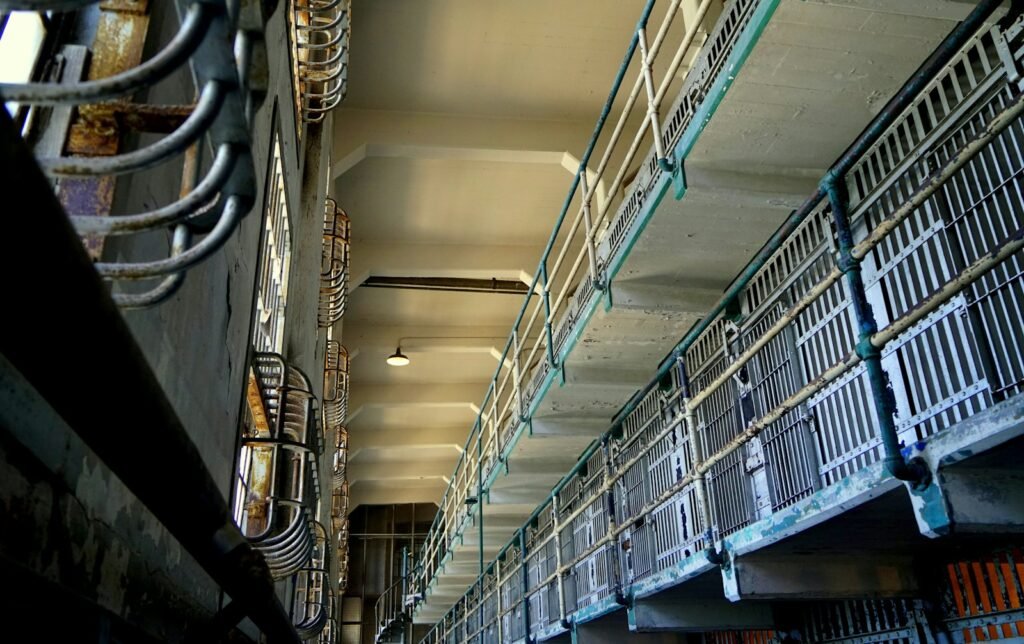
Alcatraz has been a lighthouse, a fort, an Army prison, a federal penitentiary for 29 years, the site of a Native American occupation, and, since 1972, part of a national park. The sections below take them in order, with the date and the source for each claim.
Alcatraz History at a Glance
| Year | What happened | Source |
|---|---|---|
| 1775 | Juan Manuel de Ayala maps San Francisco Bay and names the island “de los alcatraces” | NPS |
| 1850 | President Fillmore reserves the bay’s defensive lands, Alcatraz included, for public use | NPS |
| 1854 | The lighthouse begins service, the first on the Pacific Coast; the first eleven cannons are mounted | NPS |
| 1861–1865 | Civil War: Alcatraz is the only completed fort in the bay; a Confederate privateer crew is held here in 1863 | NPS |
| 1895 | Nineteen Hopi men are imprisoned for resisting forced education and land allotment | NPS |
| 1907 | Renamed the Pacific Branch, U.S. Military Prison | NPS |
| 1912 | The cellhouse, built with convict labor, is finished and prisoners move in | NPS |
| 1933 | Transferred to the Federal Bureau of Prisons | NPS |
| 1934–1963 | Federal penitentiary; closes 21 March 1963 | BOP |
| 1964 | Five Sicangu Lakota land on 9 March for about four hours | NPS |
| 1969–1971 | Occupation by Indians of All Tribes, 20 November 1969 to June 1971 | NPS |
| 1972–1973 | Golden Gate National Recreation Area created; Alcatraz opens to the public in 1973 | NPS |
Lighthouse and Fort: 1775 to the Civil War
The name comes from Ayala’s 1775 map, where the island appears as “de los alcatraces”. The United States took California after the Mexican-American War, and in 1850 President Fillmore reserved the bay’s defensive lands, Alcatraz among them.
The lighthouse began service in 1854 and the National Park Service calls it the first lighthouse on the Pacific Coast. Eleven cannons went up the same year, and by the early 1860s the island had 111. The defenses included a three-story citadel on top of the island, an armed barracks and a last line of defense.
The Civil War was the fort’s most important period. The NPS says Alcatraz was the only completed fort in the bay and helped protect San Francisco from Confederate raiders; ten thousand rifles were moved here early in the war. In 1863 the crew of a Confederate privateer was imprisoned here.
The Army Prison, 1861 to 1933
The Army held prisoners here from the Civil War on. A temporary lower prison was built in 1863 and an upper one in 1900. In 1895 nineteen Hopi men were held on the island for resisting forced education and land allotment policies. The Spanish-American War crowded the prison in 1898. In 1907 the fortress became the Pacific Branch, U.S. Military Prison, and in 1915 it was renamed the United States Disciplinary Barracks.
The cellhouse visitors walk through today was finished in 1912, built with convict labor. In 1933 the Army handed Alcatraz to the Federal Bureau of Prisons, and 32 of the worst military prisoners stayed on the island in civilian custody.
The Federal Penitentiary, 1934 to 1963
The Bureau of Prisons gives the penitentiary’s run as 1934 to 1963, 29 years. James A. Johnston was warden for the first fourteen of them. The average population was about 260 to 275 men against a capacity of 336, and the prison never filled. It held less than one percent of all federal prisoners at any time, one man to a cell.
The escapes. The Bureau counts 14 separate attempts involving 36 men, two of whom tried twice. Of those men, 23 were caught, 6 were shot and killed and 2 drowned. The best known is June 1962, when Frank Morris and brothers John and Clarence Anglin vanished from their cells on 11 June. The Bureau lists them as “missing and presumed drowned”. Allen West was still in his cell the next morning.
Why it closed. Not because of the 1962 escape: the Bureau says the decision came earlier and was about cost. In 1959 each inmate cost $10.10 a day against $3.00 at the Atlanta penitentiary. Nearly a million gallons of water a week arrived by boat, and repairs were estimated at $3 to 5 million. The prison closed on 21 March 1963.
Local Legend: The Ghost of Cell 14D, Alcatraz
What is actually true: These stories are told by FoundSF, KQED, SFGATE and 7×7, not by the National Park Service. What NPS does document: the cellhouse was built between 1910 and 1912, while Alcatraz was still a military prison, and D-Block held the most troublesome inmates in solitary confinement. It is the most visited site in the Golden Gate National Recreation Area.
The Occupation, 1964 to 1971
The first landing was short. On 9 March 1964 five Sicangu Lakota, led by Belva Cottier and Richard McKenzie, took the island for about four hours.
The second held. On 9 November 1969 Richard Oakes, an Akwesasne Mohawk, and supporters sailed out on a chartered boat, the Monte Cristo, to claim the island symbolically, and left that evening. On 20 November 1969 the claim became a full occupation by roughly 100 people, including about 80 UCLA students, under the name Indians of All Tribes. The occupation lasted until June 1971; the NPS gives both 10 and 11 June as the day federal agents removed the last occupiers.
The NPS calls it perhaps the most influential period in the island’s history. Each Indigenous Peoples’ Day it is remembered with the Alcatraz Sunrise Gathering.
National Park, 1972 to Today
Congress created the Golden Gate National Recreation Area in 1972, and Alcatraz opened to the public in 1973. Today the only way to the island is the ferry from Pier 33. Before you book, read Is Alcatraz OK for young kids? for the walk up from the dock and the closure for dock repairs from 26 October to 18 November 2026, and three days in San Francisco for where it fits in a trip.
Still Unconfirmed
- What “alcatraces” means. It is often given as pelicans or strange birds. The NPS page we read dates the name but does not translate it.
- Who lived here before 1775. The NPS pages we read do not cover earlier Native use of the island, so we have not written it.
- How many cells. The NPS describes the cellhouse as 600 single cells; the Bureau of Prisons gives the penitentiary’s capacity as 336. We have not found a source that reconciles the two.
- What happened to Morris and the Anglins. The Bureau lists them as missing and presumed drowned. Nothing we found settles it. The story that they survived is a legend, on our legends page.
Sources
- National Park Service, Alcatraz Island, Alcatraz Military Timeline, read 20 October 2026.
- National Park Service, Alcatraz Island, Fortress Alcatraz, read 20 October 2026.
- National Park Service, Alcatraz Island, U.S. Penitentiary Alcatraz, read 20 October 2026.
- National Park Service, Alcatraz Island, We Hold the Rock, read 20 October 2026.
- National Park Service, Golden Gate NRA, Centuries of Defense: National Park Service Era, read 20 October 2026.
- Federal Bureau of Prisons, Alcatraz, read 20 October 2026.
Dates and figures are as the sources state them, read on 20 October 2026. Where two sources differ, we say so above.
More Guides
San Francisco Cable Car History: 1873 to Today
San Francisco cable car history with dates and sources: Hallidie's first run in 1873, the 1947 vote that saved them, the 1964…
Read the guide →San Francisco Chinatown History: From the Gold Rush to 1906 and After
San Francisco Chinatown history with dates and sources: the Gold Rush, the 1882 Exclusion Act, the 1906 fire and the failed plan…
Read the guide →1906 San Francisco Earthquake and Fire: What Happened
The 1906 San Francisco earthquake and fire in numbers, from the USGS, National Archives and NPS: 5:12 a.m., three days of fire,…
Read the guide →Questions People Ask About Alcatraz History: Lighthouse, Fort, Prison and the 1969 Occupation
When was Alcatraz a federal prison?
From 1934 to 21 March 1963, 29 years, according to the Federal Bureau of Prisons. Before that it was an Army prison, and the Army handed it to the Bureau in 1933.
Why did Alcatraz close?
Cost. The Bureau of Prisons says the decision came before the 1962 escape: in 1959 an inmate cost $10.10 a day against $3.00 at Atlanta, and nearly a million gallons of water a week came by boat.
Did anyone escape from Alcatraz?
The Bureau counts 14 attempts by 36 men; 23 were caught, 6 were shot and 2 drowned. Frank Morris and John and Clarence Anglin vanished on 11 June 1962 and are listed as missing and presumed drowned.
When did Native Americans occupy Alcatraz?
A group calling itself Indians of All Tribes held the island from 20 November 1969 until June 1971. An earlier four-hour landing by five Sicangu Lakota took place on 9 March 1964.
When did Alcatraz become a national park site?
The Golden Gate National Recreation Area was created in 1972 and Alcatraz opened to the public in 1973.
More to Explore
Happening Soon
- Treasures of the Pharaohs Sat, Aug 1, 2026 – Jan 31, 2027 · de Young Museum
- Ferry Plaza Farmers Market Sat, Sep 12 – Dec 31 · Ferry Building Plaza
- Heart of the City Farmers Market Sun, Sep 13 – Dec 31 · Fulton Plaza, Civic Center
- SF State Observatory Public Nights (Wed–Fri, through Dec 4) Thu, Oct 1 – Dec 4 · SF State Observatory, Thornton Hall
Places to Check Out
- Aquarium of the Bay Attractions
- Asian Art Museum Museums
- Balmy Alley Murals Attractions
- Berggruen Gallery Art Galleries
Cite this page: Project SF, “Alcatraz History: Lighthouse, Fort, Prison and the 1969 Occupation”, projectsf.com/guides/alcatraz-history/ (updated ).