
San Francisco’s Chinatown grew out of the Gold Rush, was fenced in by law, was nearly erased in 1906 and then rebuilt. Chinese Americans became the city’s largest ethnic group in 2006. This is the timeline, with the source for each date.
Chinatown History at a Glance
| Year | What happened | Source |
|---|---|---|
| 1849 | 325 Chinese miners are counted in the Gold Country; by 1851 about 25,000 are in the mining area | SF Planning |
| 1852 | Chinese stonemasons assembling the Parrott Granite Block strike over wages, the earliest recorded strike by Chinese immigrants | SF Planning; CHSA |
| 1860 / 1870 / 1880 | Chinese in San Francisco: about 2,719 (5% of the city), 12,030 (about 8%), 21,213 | SF Planning |
| 1863 | The Chinese Consolidated Benevolent Associations (the Six Companies) are established | CHSA |
| 1882 | Chinese Exclusion Act bars entry except for merchants, ministers, students and travelers | CHSA |
| 1900 | A barbed-wire barricade quarantines Chinatown | SF Planning |
| 1906 | Earthquake and fire level Chinatown; firefighters dynamite Stockton Street as a firebreak; the city tries to move the Chinese out and fails | CHSA; NPS |
| 1910 | Angel Island Immigration Station opens; San Francisco’s Chinese population falls to 15,000 | CHSA |
| 1963–2001 | Chinese Historical Society of America founded 1963; first Chinese American historical museum 1967; museum and learning center opens 2001 | CHSA |
| 2006 | Chinese Americans become San Francisco’s largest ethnic population | CHSA |
The Gold Rush and the First Chinatown
The San Francisco Planning Department counts 325 Chinese miners in the Gold Country in 1849 and about 25,000 in the mining area by 1851. By 1860 about 2,719 Chinese lived in San Francisco, around 5 percent of the population; by 1870 the figure was 12,030, about 8 percent, and by 1880 it was 21,213. In 1852 Chinese stonemasons assembling a prefabricated stone building at Montgomery and California streets went on strike over wages, which the Planning Department calls the earliest recorded strike by Chinese immigrants.
Exclusion and Quarantine
The Chinese Consolidated Benevolent Associations, known as the Six Companies, were set up in 1863. In 1882 the Chinese Exclusion Act barred entry except for merchants, ministers, students and travelers; the Planning Department says it ran for 61 years. In 1900 a barbed-wire barricade quarantined Chinatown. In 1910 the Angel Island Immigration Station opened, and San Francisco’s Chinese population fell to 15,000.
1906: Destruction and the Fight to Stay
The earthquake and fire leveled Chinatown, and firefighters dynamited Stockton Street as a firebreak (CHSA). The NPS says about 15,000 Chinese residents lost nearly everything, most left for Oakland and only about 400 remained in San Francisco. Some officials had wanted to move Chinatown to Hunters Point and acquire its valuable land even before the earthquake, and after it they tried to drive the Chinese out. The Army moved those who remained into segregated camps, the last in a remote, cold, windy part of the Presidio near Fort Point; the NPS says the Chinese were the only ethnic group segregated in the refugee camps. The relocation plan failed once officials realized the city would lose tax revenue and profitable trade, and the Chinese were allowed to return and rebuild. The wider disaster is in our 1906 earthquake history.
Rebuilding, and the Look of Chinatown
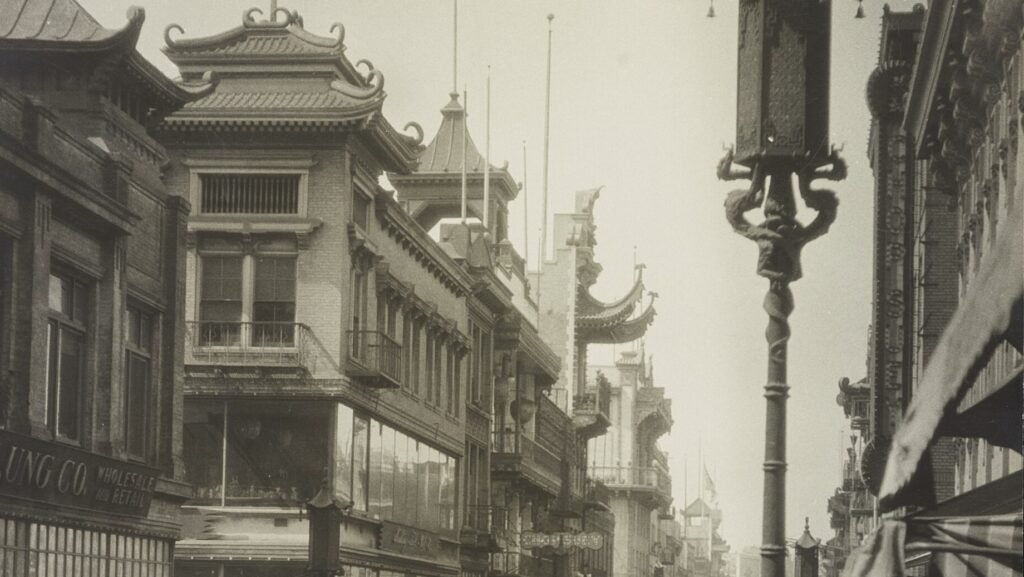
The Planning Department’s draft context statement carries a caption that says Chinatown buildings before the quake had no “Asian” architectural features, which points to the pagoda-roofed look arriving in the rebuilding rather than before it. We have not found a fuller source for who designed what, so we leave it there. The Chinese Chamber of Commerce was founded in 1908, the Chinese YMCA in 1911 and the Chinese YWCA in 1916 (CHSA).
Chinatown Today
The Chinese Historical Society of America was founded in 1963, opened the first Chinese American historical museum in the country in 1967, and opened its current museum and learning center in 2001; see its museum listing. The 1989 Loma Prieta earthquake cut Chinatown tourism by 20 to 40 percent, and in 2006 Chinese Americans became the city’s largest ethnic group (CHSA).
Local Legend: The Chinatown Tunnels That Never Were
What is actually true: It is a myth, and not a harmless one. SFGATE traces it to tour guides of the late 1800s, who led visitors through ordinary connected cellars under Grant Avenue and told them they were six or seven storeys down, when they were never more than one below the street; some of the “opium den” scenes were staged for tourists. KALW, asking Cameron House and the Chinese Culture Center, found basements, not tunnels, and heard that the rumor still feeds stereotypes about the neighborhood. We include it so you can recognize it if a tour guide tries it on you.
Still Unconfirmed
- Why the buildings look the way they do. The Planning Department says pre-1906 Chinatown had no “Asian” architectural features, but we found no source naming the designers of the rebuilt look.
- When the Exclusion Act ended. The CHSA timeline we read says the laws ended in the World War II era but gives no single year, so we do not state one.
- Who lived here before the Gold Rush. Not covered by the pages we read.
Sources
- Chinese Historical Society of America, Chinatown Rising timeline, 1906–2006, read 20 October 2026.
- San Francisco Planning Department, San Francisco Chinese American Historic Context Statement (draft), read 20 October 2026.
- National Park Service, Presidio, 1906 Earthquake: Chinese Displacement, read 20 October 2026.
Dates and figures are as the sources state them, read on 20 October 2026.
More Guides
San Francisco Cable Car History: 1873 to Today
San Francisco cable car history with dates and sources: Hallidie's first run in 1873, the 1947 vote that saved them, the 1964…
Read the guide →1906 San Francisco Earthquake and Fire: What Happened
The 1906 San Francisco earthquake and fire in numbers, from the USGS, National Archives and NPS: 5:12 a.m., three days of fire,…
Read the guide →Alcatraz History: Lighthouse, Fort, Prison and the 1969 Occupation
Alcatraz history in order, from the 1854 lighthouse to the 1934-1963 federal penitentiary and the 1969-1971 Native American occupation, with the source…
Read the guide →Questions People Ask About San Francisco Chinatown History: From the Gold Rush to 1906 and After
When did the Chinese first come to San Francisco?
With the Gold Rush. The San Francisco Planning Department counts 325 Chinese miners in the Gold Country in 1849 and about 25,000 in the mining area by 1851; about 2,719 Chinese lived in San Francisco itself by 1860.
What happened to Chinatown in 1906?
The earthquake and fire leveled it. The NPS says its roughly 15,000 residents lost nearly everything and only about 400 stayed in San Francisco. City officials tried to move Chinatown to Hunters Point, but the plan failed and the community rebuilt.
Were Chinese refugees treated differently after the 1906 earthquake?
Yes. The NPS says the Army moved the remaining Chinese into segregated camps, the last near Fort Point in the Presidio, and that they were the only ethnic group segregated in the refugee camps.
Are there tunnels under Chinatown?
No. It is a myth traced to late-1800s tour guides, who led visitors through ordinary basements and said they were several storeys down; see the legend above.
When was the Chinese Exclusion Act passed?
1882. It barred entry except for merchants, ministers, students and travelers, and the Planning Department says it ran for 61 years.
More to Explore
Happening Soon
- Treasures of the Pharaohs Sat, Aug 1, 2026 – Jan 31, 2027 · de Young Museum
- Ferry Plaza Farmers Market Sat, Sep 12 – Dec 31 · Ferry Building Plaza
- Heart of the City Farmers Market Sun, Sep 13 – Dec 31 · Fulton Plaza, Civic Center
- SF State Observatory Public Nights (Wed–Fri, through Dec 4) Thu, Oct 1 – Dec 4 · SF State Observatory, Thornton Hall
Places to Check Out
- Aquarium of the Bay Attractions
- Asian Art Museum Museums
- Balmy Alley Murals Attractions
- Berggruen Gallery Art Galleries
Cite this page: Project SF, “San Francisco Chinatown History: From the Gold Rush to 1906 and After”, projectsf.com/guides/chinatown-san-francisco-history/ (updated ).