
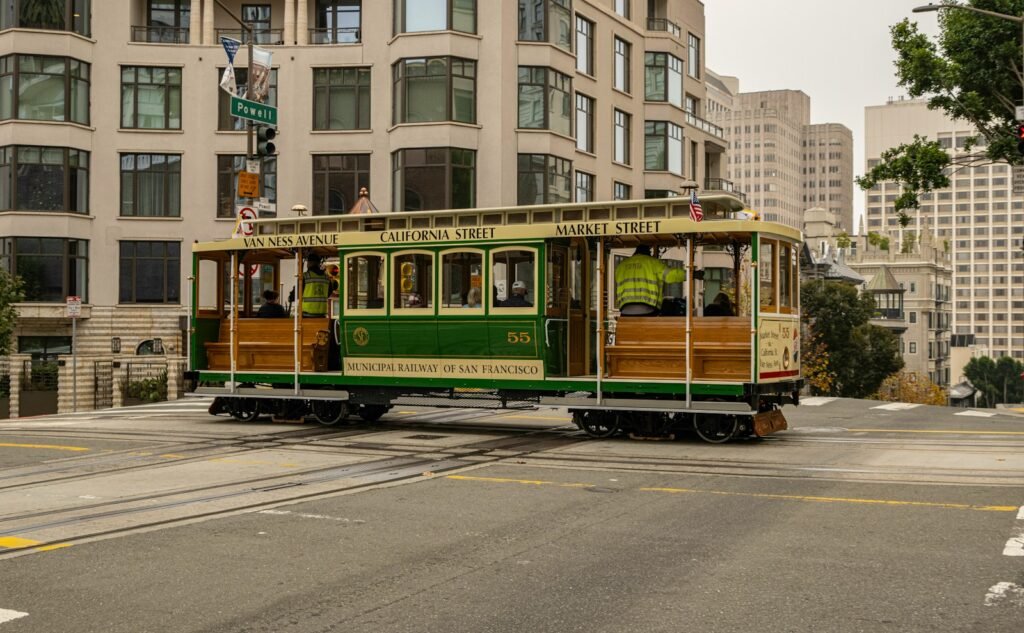
San Francisco’s cable cars made their first run at 4 a.m. on 2 August 1873 on Clay Street, were nearly scrapped in 1947 and are now a National Landmark. Three lines still run. Here is how they got from a Nob Hill experiment to one of the two National Historic Streetcar Landmarks still in operation, as the SFMTA puts it.
Cable Car History at a Glance
| Year | What happened | Source |
|---|---|---|
| 1869 | Andrew Hallidie conceives the idea (the horse story is lore; see below) | Cable Car Museum |
| 2 Aug 1873 | First test, 4 a.m. on Clay Street, a day after the city’s contract deadline | SFMTA; Cable Car Museum |
| 1 Sep 1873 | The Clay Street Hill Railroad begins public service | SFMTA |
| 1873–1889 | Eight companies lay 53 miles of track at their height | SFMTA |
| 1906 | The earthquake and fire devastate the system; electric streetcars become the preferred transit, though some cable lines are rebuilt | Cable Car Museum |
| 1947 | Mayor Roger Lapham wants the lines gone; Friedel Klussmann founds the Citizens’ Committee to Save the Cable Cars; Measure 10 passes in a landslide | SFMTA |
| 1949 | Another vote leads the city to acquire the California Street Cable Railroad | SFMTA |
| 1964 | Cable car system designated a National Landmark | SFMTA |
| 1982–1984 | Complete shutdown for a major rebuild; cars return in June 1984 | SFMTA |
1873: The First Line
The Cable Car Museum says the Clay Street Hill Railroad began building its line in May 1873, and its city contract required it to run by 1 August. Andrew Smith Hallidie tested the first car at 4 a.m. on 2 August, a day late, and public service began on 1 September 1873. By 1889 eight companies had operated cable lines in the city and laid 53 miles of track, according to the SFMTA.
Local Legend: The Horses That Inspired the Cable Car, Nob Hill
What is actually true: SFMTA says “legend has it” and the Cable Car Museum says “as the story goes”: the account comes from Hallidie’s own recollection years later. The rest is well documented. The first cable car made its test run at about 4am on 2 August 1873 on Clay Street, and public service began on 1 September 1873. Hallidie knew wire rope from his father’s patent and his mining work, and William Eppelsheimer engineered the system.
1906 and the Rise of Electric Streetcars
The Cable Car Museum says the April 1906 earthquake and fire devastated the system and that electric streetcars became the preferred transit afterward, though some cable lines were rebuilt. The SFMTA notes the Washington-Mason cable car house was rebuilt. More on the disaster is in our 1906 earthquake history.
1947: The Fight to Save Them
In 1947 Mayor Roger Lapham said the city should get rid of all cable car lines as soon as possible, and buses were scheduled to replace the Powell Street lines. Friedel Klussmann founded the Citizens’ Committee to Save the Cable Cars. Voters passed Measure 10 in a landslide, forcing the city to keep the Powell lines. In 1949 another vote led the city to acquire the California Street Cable Railroad. The SFMTA says the system had five lines when the fight began and was cut and reconfigured into the three that run today, saved “not without heavy losses”.
Landmark Status and the Great Rebuild
The SFMTA says the system was established as a National Landmark in 1964, covering everything from the powerhouse and cable winding machinery to the tracks and turntables; it was added to the National Register of Historic Places in 1966. A major restoration shut the system completely from 1982 to 1984, and the cars returned in June 1984.
How the Cable Cars Run Today
Cars are pulled along by cables running beneath the street. The cable is moved by winding machinery, and special rail pieces guide it over hills and around bends; depression beams push against it where the road dips to keep it out of its channel. Splicing a cable is still done by hand. The California line uses twelve larger, double-ended maroon cars, and the two Powell lines keep 28 smaller, single-ended cars on the roster, according to the SFMTA. The lines are:
- California: California and Market to Van Ness Avenue.
- Powell-Hyde: Powell and Market to the Fisherman’s Wharf area.
- Powell-Mason: Powell and Market to the Fisherman’s Wharf area.
Fares and what to expect on board are in our Muni, BART and cable cars with kids guide and the Cable Car Museum listing.
Still Unconfirmed
- The horse story. The Cable Car Museum itself presents it as “as the story goes”, and SFMTA says “legend has it”. It comes from Hallidie’s own later recollection.
- The cable’s speed. A speed figure is often quoted; it was not on the SFMTA or museum pages we read, so we do not print one.
- Today’s fare. Not on the SFMTA pages we read for this history; check the SFMTA fare page before you ride.
Sources
- San Francisco Municipal Transportation Agency, Cable Car History, read 20 October 2026.
- Cable Car Museum, Cable Car Heritage, read 20 October 2026.
- SFMTA, 75 Years After the Battle to Save the Cable Cars, read 20 October 2026.
- SFMTA, Ringing In 55 Years of Landmark Status, read 20 October 2026.
- SFMTA, Cable Cars, read 20 October 2026.
- SFMTA, Then and Now: Keeping the Cable Cars on the Move, read 20 October 2026.
Dates and figures are as the sources state them, read on 20 October 2026.
More Guides
San Francisco Chinatown History: From the Gold Rush to 1906 and After
San Francisco Chinatown history with dates and sources: the Gold Rush, the 1882 Exclusion Act, the 1906 fire and the failed plan…
Read the guide →1906 San Francisco Earthquake and Fire: What Happened
The 1906 San Francisco earthquake and fire in numbers, from the USGS, National Archives and NPS: 5:12 a.m., three days of fire,…
Read the guide →Alcatraz History: Lighthouse, Fort, Prison and the 1969 Occupation
Alcatraz history in order, from the 1854 lighthouse to the 1934-1963 federal penitentiary and the 1969-1971 Native American occupation, with the source…
Read the guide →Questions People Ask About San Francisco Cable Car History: 1873 to Today
When did the first San Francisco cable car run?
At 4 a.m. on 2 August 1873 on Clay Street, tested by Andrew Smith Hallidie. Public service began on 1 September 1873.
Why are San Francisco cable cars still running?
Because voters saved them. In 1947 Mayor Roger Lapham wanted the lines gone, Friedel Klussmann’s Citizens’ Committee to Save the Cable Cars organized, and Measure 10 passed in a landslide, forcing the city to keep the Powell Street lines.
How many cable car lines does San Francisco have?
Three: California, Powell-Hyde and Powell-Mason. The system had five lines when the 1947 fight began, according to the SFMTA.
When did the cable cars become a National Landmark?
1964, according to the SFMTA. The designation covers the whole system, from the powerhouse and winding machinery to the tracks and turntables.
When were the cable cars shut down for rebuilding?
From 1982 to 1984. The system was completely shut for a major restoration and the cars returned in June 1984.
More to Explore
Happening Soon
- Treasures of the Pharaohs Sat, Aug 1, 2026 – Jan 31, 2027 · de Young Museum
- Ferry Plaza Farmers Market Sat, Sep 12 – Dec 31 · Ferry Building Plaza
- Heart of the City Farmers Market Sun, Sep 13 – Dec 31 · Fulton Plaza, Civic Center
- SF State Observatory Public Nights (Wed–Fri, through Dec 4) Thu, Oct 1 – Dec 4 · SF State Observatory, Thornton Hall
Places to Check Out
- Aquarium of the Bay Attractions
- Asian Art Museum Museums
- Balmy Alley Murals Attractions
- Berggruen Gallery Art Galleries
Cite this page: Project SF, “San Francisco Cable Car History: 1873 to Today”, projectsf.com/guides/san-francisco-cable-car-history/ (updated ).