
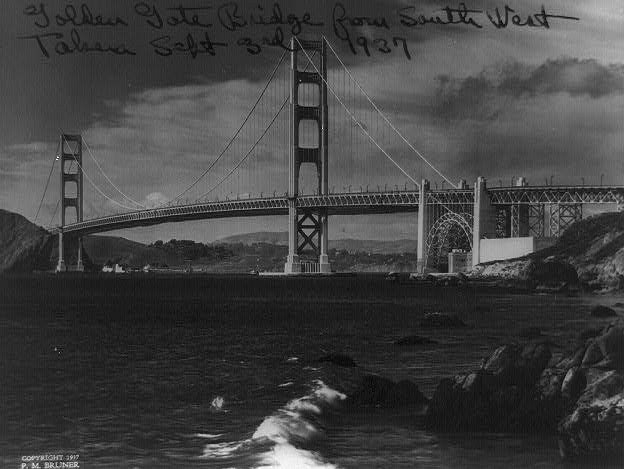
The Golden Gate Bridge opened to people on foot on 27 May 1937 and to cars the next day at noon. Getting there took 16 years from the first sketch, a $35 million bond vote and four years of building.
| When | What happened | Source |
|---|---|---|
| May 1920 | Engineers consulted by city engineer O’Shaughnessy say a bridge could cost more than $100 million; Joseph B. Strauss says $25 to $30 million | Golden Gate Bridge and Highway District |
| 28 Jun 1921 | Strauss submits a design with a $27 million estimate (the District notes sources vary from $17 million to $27 million) | Golden Gate Bridge and Highway District |
| 7 Dec 1922 | O’Shaughnessy makes the Strauss design public | Golden Gate Bridge and Highway District |
| 15 Aug 1929 | The District board appoints Strauss chief engineer | Golden Gate Bridge and Highway District |
| Summer 1930 | Architect Irving Morrow is hired for the design treatment: the Art Deco lines, the burnt red-orange colour and the lighting | Golden Gate Bridge and Highway District |
| 11 Aug 1930 | The War Department issues its final permit: a suspension bridge with a 4,200-foot main span | Golden Gate Bridge and Highway District |
| 4 Nov 1930 | Voters approve a $35 million bond issue, 145,657 for and 46,954 against | Golden Gate Bridge and Highway District |
| 5 Jan 1933 | Official start of construction (groundbreaking ceremony at Crissy Field on 26 February 1933) | Golden Gate Bridge and Highway District |
| 20 Nov 1936 | The two sections of the main span are joined | Golden Gate Bridge and Highway District |
| 17 Feb 1937 | Scaffolding falls into the safety net and 10 workers die | Golden Gate Bridge and Highway District |
| 27–28 May 1937 | Pedestrians cross on 27 May; vehicle traffic opens at noon on 28 May, announced by President Franklin D. Roosevelt | Golden Gate Bridge and Highway District |
| 1 Jul 1971 | The original bonds are retired: $35 million of principal and nearly $39 million of interest, paid entirely from tolls | Golden Gate Bridge and Highway District |
| 4 Jul 2026 | Free fireworks launch from the bridge for the US 250th anniversary, the city’s only official fireworks show that year | SF.gov |
1920 to 1930: Arguing Over the Price
The first fight over the bridge was about money. In May 1920 the engineers consulted by City Engineer O’Shaughnessy said it could cost more than $100 million, and Joseph B. Strauss said $25 to $30 million. His June 1921 design carried a $27 million estimate; the District points out that published figures for that sketch run from $17 million to $27 million. Strauss applied for a patent that December, and the District lists the patent as granted on 24 April 1923. The District board named him chief engineer on 15 August 1929.
Summer 1930 brought the architect. The District credits Irving Morrow with the Art Deco styling, the red-orange colour and the lighting. On 11 August 1930 the War Department issued the permit for a suspension bridge with a 4,200-foot main span, 220 feet of clearance at midspan and 210 feet at the sidespans.
The 1930 Vote
On 4 November 1930 voters approved a $35 million bond issue by 145,657 to 46,954, as the District records it. In July 1931 the construction bids came in within that budget.
1933 to 1937: Building It
Construction officially began on 5 January 1933, and the groundbreaking ceremony followed on 26 February 1933 at Crissy Field. The two halves of the main span were joined on 20 November 1936. On 17 February 1937 scaffolding fell into the safety net and 10 workers died; the District’s page records the date and the number. The bridge opened to pedestrians on 27 May and to vehicles on 28 May 1937.
Who Paid
The District says the bonds were retired on 1 July 1971, with $35 million in principal and nearly $39 million in interest paid entirely from tolls. Nothing in the District page says taxpayers covered the bonds.
See the Bridge Today
For where to stand and when the fog allows it, read the best views in San Francisco. The bridge approaches sit inside the Presidio, and Fort Point sits directly beneath the south end.
Still Unconfirmed
- Cost of the 1921 sketch. The District says sources vary from $17 million to $27 million; we print the range, not one number.
- The colour’s name. The District page describes a burnt red-orange hue and does not use another name for it, so we do not either.
- Tower height and total length. Not on the District page we read, so we print none; check the District before quoting one.
More San Francisco History
Keep going with the San Francisco history hub: a 58-event timeline, historic sites to visit, history tours (many free) and the National Historic Landmarks. Prefer stories people tell? Try the local legends, fact-checked.
Sources
- Golden Gate Bridge and Highway District, Key Dates, read 27 October 2026.
- San Francisco Mayor’s Office via SF.gov, Mayor Lurie to light up Golden Gate Bridge for US 250th, read 27 October 2026.
Dates and figures are as the sources state them, read on 27 October 2026.
More Guides
Presidio Ghosts and the Pet Cemetery: Legends and Facts
The Presidio’s ghost stories and the Pet Cemetery legends, told as stories and then checked against the Presidio Trust and National Park…
Read the guide →Chinatown Tunnels Myth: What Is Under Grant Avenue
The claim that a maze of tunnels runs under San Francisco Chinatown, traced to 1800s tour guides, and what SFGATE and KALW…
Read the guide →Is Coit Tower a Fire Hose Nozzle? The Legend and the Facts
The story that Coit Tower was shaped like a fire hose nozzle to honour firefighters, and what San Francisco Recreation and Parks…
Read the guide →Questions People Ask About Golden Gate Bridge History: 1921 Sketch to 1937 Opening
When did the Golden Gate Bridge open?
To pedestrians on 27 May 1937 and to vehicle traffic at noon on 28 May 1937, according to the Golden Gate Bridge Highway and Transportation District.
When did construction start?
Construction officially began on 5 January 1933, with a groundbreaking ceremony at Crissy Field on 26 February 1933.
How was the bridge paid for?
With a $35 million bond issue that voters approved on 4 November 1930. The District says tolls alone repaid the bonds, with the last retired on 1 July 1971.
How long is the main span?
The War Department permit of 11 August 1930 was for a suspension bridge with a 4,200-foot main span.
How many workers died building it?
The District records that 10 workers died on 17 February 1937 when scaffolding fell into the safety net.
More to Explore
Happening Soon
- Treasures of the Pharaohs Sat, Aug 1, 2026 – Jan 31, 2027 · de Young Museum
- Ferry Plaza Farmers Market Sat, Sep 12 – Dec 31 · Ferry Building Plaza
- Heart of the City Farmers Market Sun, Sep 13 – Dec 31 · Fulton Plaza, Civic Center
- SF State Observatory Public Nights (Wed–Fri, through Dec 4) Thu, Oct 1 – Dec 4 · SF State Observatory, Thornton Hall
Places to Check Out
- Aquarium of the Bay Attractions
- Asian Art Museum Museums
- Balmy Alley Murals Attractions
- Berggruen Gallery Art Galleries
Cite this page: Project SF, “Golden Gate Bridge History: 1921 Sketch to 1937 Opening”, projectsf.com/guides/golden-gate-bridge-history/ (updated ).