
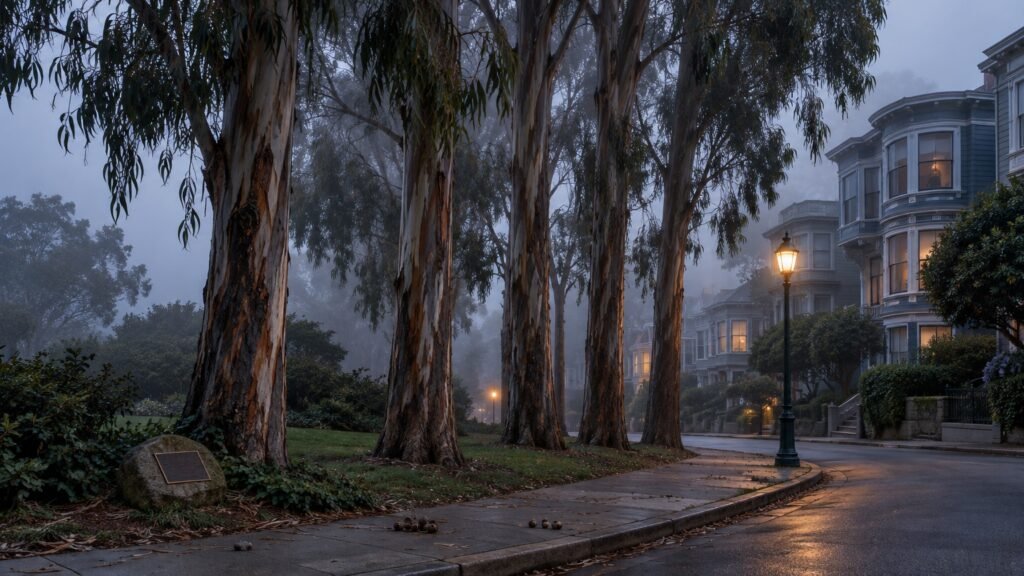
Ghost tours stop at a row of tall eucalyptus trees at Octavia and Bush and tell a spooky story about the woman who planted them. Mary Ellen Pleasant’s real life, as an entrepreneur and civil rights pioneer, is the better story.
The Legend
Who Mary Ellen Pleasant Was
The trees and the woman are real, and her real story is bigger than the ghost. San Francisco’s Department of the Environment says Pleasant was born into slavery, worked on the Underground Railroad and planted the eucalyptus trees outside her home at 1661 Octavia Street, which are now city landmark trees. KQED says she arrived in San Francisco in 1852 and built a fortune running boardinghouses and laundries. In 1866, the SF Standard reports, she refused to give up her seat on a streetcar, and her case reached the California Supreme Court in 1868. The “voodoo queen” label is the false part: KQED and the SF Standard trace it to newspaper attacks after the Sharon divorce trial of the 1880s, and historian Lynn Hudson told the SF Standard those stereotypes were rooted in slavery. The chills, the frightened dogs and the thrown nuts are ghost-tour tales, reported as stories, not fact.
The Trees and the Plaque
The eucalyptus trees stand on the site of the home she shared with Thomas and Teresa Bell, which KQED says was torn down in the late 1920s. The Alamo Square Neighborhood Association says the plaque, placed by the San Francisco African American Historical and Cultural Society, names Mary Ellen Pleasant Memorial Park, calls her the “Mother of Civil Rights in California”, and credits her with supporting the western end of the Underground Railroad from 1850 to 1865. The SF Standard calls the park the smallest public park in San Francisco.
Can You Visit?
Yes. The trees and plaque are at Octavia and Bush, on a public sidewalk in a residential neighborhood, so please keep your voice down and stay off the plantings. They are the last stop on our Western Addition legends walk.
Not confirmed. We could not confirm the following from a source we read on 6 November 2026, so treat them as unconfirmed:
- Her birth year: her own accounts disagree, according to KQED; the plaque gives 1814.
- Whether she finally won the streetcar case: we confirmed that it reached the California Supreme Court in 1868, not the final outcome.
- When her mansion was torn down: KQED says 1927, the Alamo Square Neighborhood Association says 1928.
- The ghost story itself, and the version where the trees drop branches on people, which we found in no reputable source.
More Legends and History
This is one of 36 stories in San Francisco Local Legends, fact-checked. For the dated record, start at the San Francisco history hub.
Sources
- SF Environment: Landmark trees planted by California’s mother of civil rights, read 6 November 2026.
- KQED: How a heroine became a “demon” in Victorian San Francisco, read 6 November 2026.
- SF Standard: SF’s first Black businesswoman deserves more than a ghost tour, read 6 November 2026.
- Alamo Square Neighborhood Association: Mary Ellen Pleasant, read 6 November 2026.
More Guides
San Francisco Chinese New Year Parade 2027: Date, Route, Tickets and the Street Fair
The 2027 San Francisco Chinese New Year Parade is Saturday 20 February at 5:15pm. The route, when bleacher tickets go on sale,…
Read the guide →Exploratorium vs California Academy of Sciences: Which Is Better With Kids?
Two big San Francisco science museums, two very different days out. Which one suits your children, your weather and your budget.
Read the guide →San Francisco Local Legends: Ghost Stories, Myths and What’s Actually True
Thirty-six San Francisco legends, ghost stories and origin myths, from the White Lady of Stow Lake to who invented the Mission burrito.…
Read the guide →Questions People Ask About Mary Ellen Pleasant’s Eucalyptus Trees: The Ghost Story and the Real History
Who was Mary Ellen Pleasant?
A San Francisco entrepreneur and civil rights pioneer who was born into slavery, worked on the Underground Railroad and took a streetcar segregation case to the California Supreme Court in 1868. The eucalyptus trees she planted still stand at Octavia and Bush.
Where are Mary Ellen Pleasant’s trees?
At Octavia and Bush, on the site of her old home at 1661 Octavia Street, in Mary Ellen Pleasant Memorial Park; the SF Standard calls it the smallest public park in San Francisco.
Is Mary Ellen Pleasant’s ghost real?
There is no evidence. KQED and the SF Standard report the chills, frightened dogs and thrown nuts as ghost-tour stories.
Why was she called a voodoo queen?
KQED and the SF Standard trace the label to newspaper attacks after the Sharon divorce trial of the 1880s. Historian Lynn Hudson told the SF Standard those stereotypes were rooted in slavery.
What does the plaque say?
According to the Alamo Square Neighborhood Association, it names Mary Ellen Pleasant Memorial Park and calls her the “Mother of Civil Rights in California”.
More to Explore
Places to Check Out
- Aquarium of the Bay Attractions
- Asian Art Museum Museums
- Balmy Alley Murals Attractions
- Berggruen Gallery Art Galleries
Cite this page: Project SF, “Mary Ellen Pleasant’s Eucalyptus Trees: The Ghost Story and the Real History”, projectsf.com/guides/mary-ellen-pleasant-eucalyptus-trees/ (updated ).